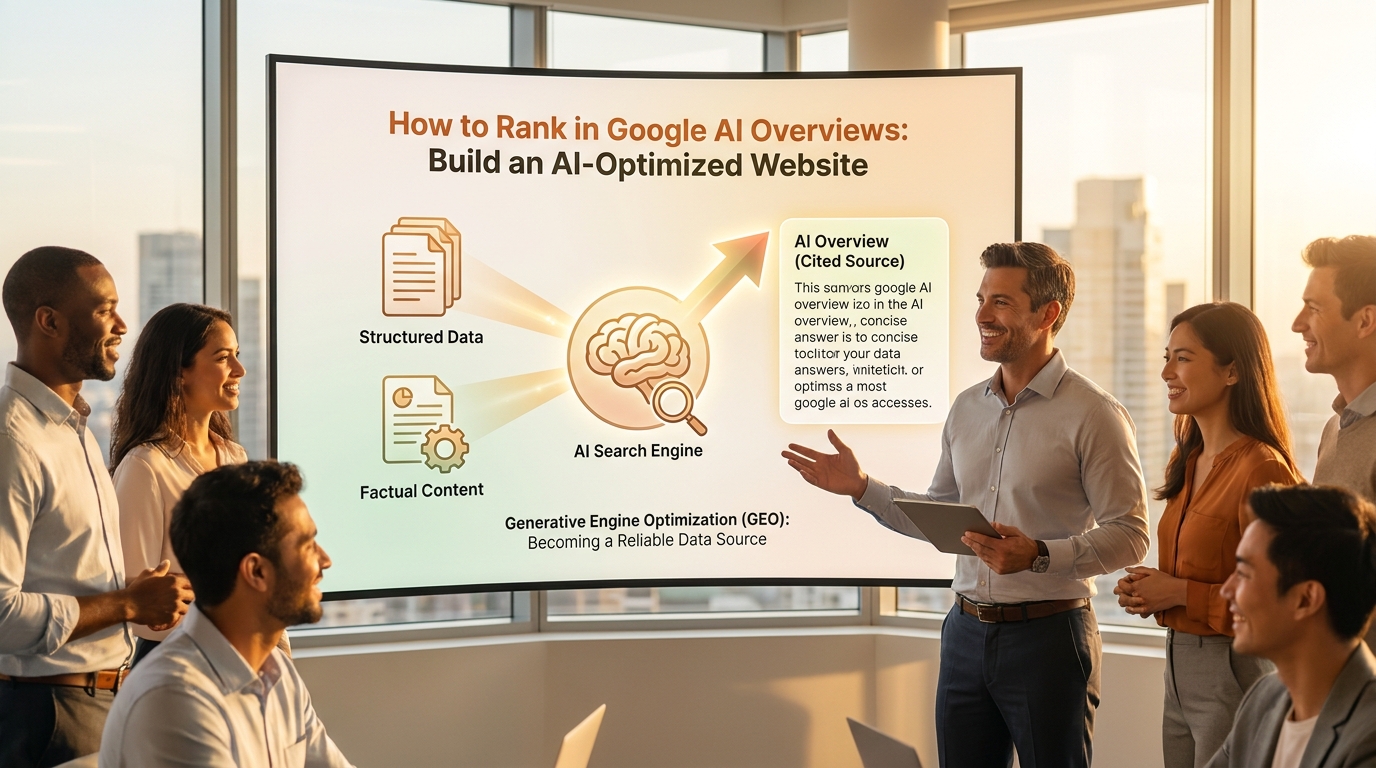
How to Rank in Google AI Overviews: Build an AI-Optimized Website
Introduction
AI search is fundamentally changing how users find information online. This guide will teach you the exact steps to build a website optimized for Generative Engine Optimization (GEO) and secure your spot as a cited source in Google AI Overviews.
Understanding the Shift: What is Generative Engine Optimization?
Generative Engine Optimization (GEO) is the systematic process of structuring, formatting, and enhancing digital content so that artificial intelligence systems—such as Google AI Overviews, ChatGPT, and Perplexity—can easily retrieve, verify, and cite it. While traditional Search Engine Optimization (SEO) relied heavily on keyword density, backlinks, and matching search queries to web pages, GEO prioritizes becoming a reliable data source for generative engines. A traditional search engine provides a list of destinations; a generative engine synthesizes data to deliver an immediate, fully-formed answer.
To rank in this new ecosystem, you must understand how Large Language Models (LLMs) process information. LLMs do not "read" pages in the traditional human sense. They rely on Retrieval-Augmented Generation (RAG) to locate relevant facts, understand entity relationships, and parse contextual meaning. If your website lacks structured entity mapping, models may bypass your content entirely or "hallucinate" incorrect facts about your brand.
Highlighting the importance of becoming a highly citable, authoritative source is no longer optional. According to a foundational Princeton University study on the topic, GEO: Generative Engine Optimization, optimizing content specifically for generative engines—such as by integrating authoritative citations and clear statistical data—can boost visibility in AI responses by up to 40%. Generative engines reward clarity, accessibility, and citability over traditional keyword saturation.
Step 1: Select the Best AI Website Builder for SEO
The foundation of your website dictates your success in AI search. LLMs favor fast, clean, and highly structured architectures. If your underlying code is bloated or lacks semantic clarity, AI crawlers will struggle to synthesize your information, drastically lowering your chances of being cited.
To achieve maximum visibility, you need a platform with built-in technical SEO, clean semantic code, and automated schema markup. The best AI website builder for SEO provides these elements natively. Platforms like Siteup.ai are explicitly engineered to satisfy the rigorous technical thresholds required by modern generative engines, ensuring that data points are mapped and relationships are logically structured without manual coding.
AI Website Builder vs WordPress SEO
For years, WordPress has been the default standard for digital publishing. However, the AI Website Builder vs WordPress SEO debate has shifted significantly as AI search has evolved. Traditional WordPress setups involve a steep learning curve and rely heavily on a patchwork of third-party plugins (like Yoast or RankMath) to manage technical SEO. This often results in bloated codebases, conflicting updates, and slower site speeds—all of which negatively impact crawler access.
In contrast, modern AI builders streamline technical SEO out-of-the-box. Instead of requiring constant manual plugin updates to maintain schema validation, platforms like Siteup.ai automatically generate clean, semantic HTML and inject precise JSON-LD structured data. This unified infrastructure means that webmasters spend less time maintaining legacy plugins and more time publishing authoritative content that AI models crave.
Step 2: Create an AI Website with SEO Infrastructure
When building an AI-optimized website, site architecture and semantic HTML are paramount. You must ensure that AI bots can easily parse your data. This is where Siteup.ai’s "Structure Information for AI" capabilities shine. By seamlessly generating robust schema markup (JSON-LD), the platform explicitly defines entities and relationships, acting as a disambiguation layer for LLMs.
A recent empirical analysis, The Impact of JSON-LD Metadata on ChatGPT Visibility, found that websites utilizing structured metadata like FAQPage and Product schemas were exponentially more likely to be recognized and cited by ChatGPT. The study showed that deploying explicit schema markup acts as a translation layer, allowing AI bots to map out your brand, services, and products securely.
Furthermore, you must ensure lightning-fast loading speeds and flawless mobile optimization to meet Google's technical thresholds. The best infrastructure also requires careful management of robots.txt files to control how specialized bots (such as OpenAI's GPTBot or Google's Google-Extended) access your site. Implementing a technical framework that guarantees maximum AI accessibility ensures your structural clarity translates directly into citation confidence.
Step 3: Structure Your Content for AI Crawlers (CORE-EEAT)
Even with perfect technical infrastructure, your text must be optimally formatted to be extracted by LLMs. You must write for humans first, but format for AI extraction using clear, descriptive headings.
Siteup.ai facilitates this through "Direct Answer Structuring." AI systems overwhelmingly favor content that answers queries quickly and decisively. You must provide direct, concise answers to complex questions at the very top of your sections—a tactic known as front-loading value. Recent findings from the May 2026 paper, Measuring Google AI Overviews: Activation, Source Quality, Claim Fidelity, and Publisher Impact, revealed that 11% of claims in AI Overviews were unsupported by their cited pages, emphasizing the desperate need for AI engines to find clear, unambiguous answers. Furthermore, industry data shows that over 55% of AI citations are pulled directly from the first 30% of a web page's content. If you bury your core answer beneath paragraphs of introductory fluff, generative engines will simply cite your competitors.
Additionally, you must back all claims with verifiable data, statistics, and expert insights to build topical authority (CORE-EEAT). Siteup.ai’s "Track User Intention" and "Compare AI Perception" features provide a distinct advantage over older platforms by analyzing behavioral signals and tracking sentiment data. By tracking how users interact with your content across platforms, you can identify positioning gaps and refine your content structure to remain a highly quotable, definitive source in your niche.
Step 4: Launch, Monitor, and Iterate
GEO is not a "set it and forget it" strategy. You must track your visibility in AI search features using modern SEO tools tailored for generative engines. Measuring metrics like prompt coverage, citation share of voice, and sentiment patterns allows you to see exactly where your brand appears when users query LLMs.
To maintain dominance, you must continuously update content to maintain freshness and accuracy. An outdated statistic is an immediate red flag for advanced RAG systems. Through the centralized siteup ai login, webmasters can access a comprehensive dashboard to seamlessly manage their site's ongoing SEO performance, ensuring that structured data is always current, brand entities are properly defined, and positioning gaps are quickly closed.
Q: How to rank in Google AI overviews? To rank in Google AI overviews, you must structure your content with direct, authoritative answers, use semantic HTML, implement schema markup, and build a strong technical SEO infrastructure.
Q: What is generative engine optimization? Generative engine optimization (GEO) is the process of optimizing website content and technical infrastructure so that AI search engines and large language models (LLMs) can easily understand, cite, and recommend it.
Q: What is the best AI website builder for SEO? The best AI website builder for SEO provides built-in technical infrastructure, automated schema markup, and clean semantic code, making platforms like Siteup.ai ideal for ranking in AI search.
Q: How does an AI website builder vs WordPress SEO compare? While WordPress requires manual configuration and multiple plugins for SEO, a dedicated AI website builder offers streamlined, built-in SEO infrastructure that is optimized specifically for modern AI search engines.
Conclusion
Generative Engine Optimization represents a fundamental shift away from simply trying to rank blue links on a results page toward becoming a foundational, trusted data source for the world's most advanced AI models. By focusing on semantic architecture, explicit entity mapping through structured data, and front-loading high-authority content, you effectively engineer your digital presence to be cited. Stop relying on outdated plugin stacks and complex legacy setups. Take control of your visibility in the generative era—build your AI-ready website with Siteup.ai today to dominate the future of search.