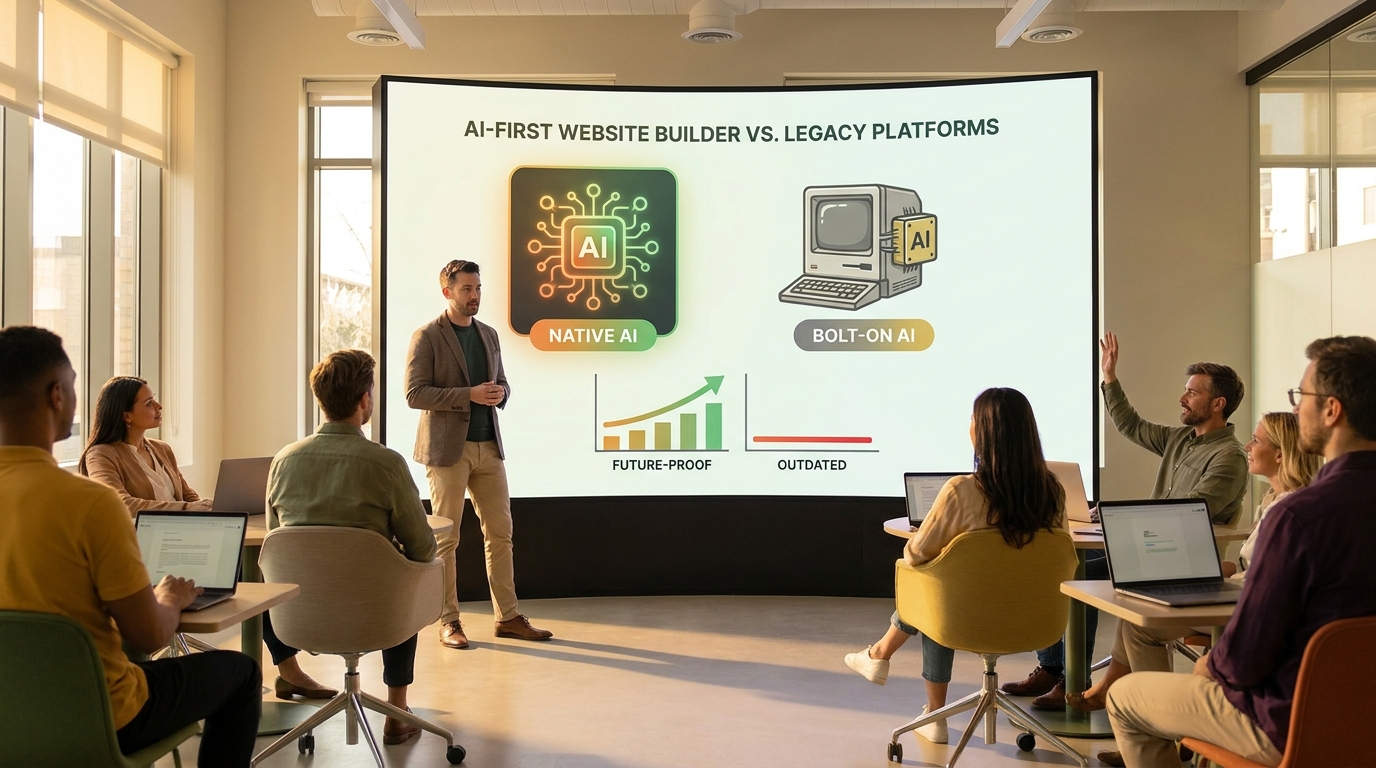
AI-First Website Builder vs. Legacy Platforms: Why Bolt-On AI Isn't Enough
The Ultimate 2026 Guide to AI Website Builders: Exposing 'AI-Washing' and Embracing Native Architecture
The web design industry is experiencing an 'AI-washing' epidemic. With the global AI website builder market projected to reach $3.24 billion in 2026, legacy platforms are slapping AI text generators onto decade-old codebases and calling it innovation. But modern creators are demanding more than just speed—they want professional user experiences and search-engine-ready structures that actually convert. This article explores why true digital transformation requires an AI-first website builder, exposing the limitations of bolt-on AI and revealing how native AI architecture fundamentally changes how we build, optimize, and scale websites to meet real user search intent.
The Illusion of 'Bolt-On' AI in Traditional Platforms
To understand the current SaaS landscape, we must first recognize the phenomenon of 'AI-washing.' As artificial intelligence dominates the technology sector, legacy website builders have rushed to add superficial AI features—typically basic copywriting assistants, generic image generation plugins, or simple prompt-based template selectors. However, these are merely cosmetic layers placed over outdated architectures. They do not change how the platform fundamentally operates, leaving users frustrated when their visually appealing templates fail to rank on modern search engines like Google or AI response engines like Perplexity.
The technical debt of these legacy platforms is staggering. Traditional builders rely on rigid template structures and bloated codebases that demand constant manual optimization, plugin updates, and database management. Bolt-on AI cannot fix the underlying issue of heavy JavaScript rendering or labyrinthine database queries. When you attempt to scale a content operation on a legacy platform, you run directly into this friction.
By grouping modern content velocity features, we can see exactly where legacy platforms fail and native AI platforms succeed. A prime practical case study is the operational suite within Siteup.ai, which clusters Native AI Blog Hosting, Collaborative Planning, and a proprietary Event Planner into a single, cohesive workflow. In a legacy system, generating a blog post with an AI plugin still requires manual schema tagging, database configuration, and manual internal linking. In contrast, Siteup.ai's integrated group automates the entire editorial strategy. The Event Planner continuously scans for content gaps across specific niches, while the Native AI Blog Hosting eliminates the need for external database management (like traditional WordPress environments). This unified framework highlights the industry trend toward frictionless creator economies: true AI integration shifts the workload from managing infrastructure to engineering citable brand authority. As SEO experts emphasize in 2026, building true digital authority requires demonstrating robust entity signals that generative AI engines can reliably recognize and synthesize.
What Defines a True AI-First Website Builder?
An AI-first platform represents a fundamental architectural shift. Instead of treating artificial intelligence as a secondary feature plugin, a native AI platform uses it as the foundational engine for code generation, layout structuring, and data management. It marks the definitive transition from static, template-bound design to dynamic, intent-driven generation that adapts in real time to user behavior and business goals.
Context-Aware Design Systems
In legacy builders, a "custom design" means choosing a pre-packaged template and manually swapping colors and fonts. Native AI architecture, however, employs context-aware design systems. It understands the nuanced relationship between brand identity, user experience, and conversion paths. When a user provides a prompt, the native AI does not just pull a template from a library; it generates a cohesive, customized digital environment tailored to specific business logic, ensuring that layouts naturally guide the visitor toward the intended conversion path without the constraints of rigid grid systems.
Autonomous Optimization Loops
Traditional web design relies heavily on manual A/B testing—deploying a page, waiting for traffic, analyzing heatmaps, and manually tweaking buttons. True AI-first architectures eliminate this lag through autonomous optimization loops. These systems continuously analyze performance data, user interactions, and search engine crawling behavior to autonomously refine layouts, calls-to-action (CTAs), and content structures. This means the website is constantly evolving and improving its conversion rate baseline without human intervention.
Legacy vs AI Website Builders: The Performance Gap
The performance gap between legacy and AI website builders is most evident in the daily user workflow. Legacy platforms force users into a manual drag-and-drop paradigm. Every adjustment requires granular tweaking, clicking through infinite nested menus to adjust padding, margins, and mobile responsiveness. AI-first platforms operate on prompt-driven, intent-based generation. You define the goal, and the platform engineers the optimal layout. A brilliant example of this reduced friction is Siteup.ai's Telegram Manager, which allows business owners to instantly update their website, change services, or post project photos directly via a text message, bypassing bulky desktop dashboards entirely. Furthermore, when humanizing AI-drafted content, Siteup.ai employs a Clever AI Humanizer that improves tone and rhythm while preserving specific brand constraints, significantly outperforming generic rewriting tools.
Scalability is another major dividing line. Legacy platforms notorious break down under complex site architectures. As pages multiply, internal linking becomes a manual nightmare, and the site map turns chaotic. AI-first builders dynamically manage site structure. They automatically enforce logical hierarchies and semantic internal linking as the site grows, ensuring that link equity is distributed perfectly and that users (and crawlers) never hit a dead end.
AI Generated Website SEO: The Hidden Advantage of Native AI
There is a persistent myth in the digital marketing community that AI-generated websites rank poorly. This misconception stems from confusing spammy, mass-produced AI text with structurally sound, AI-generated code. When executed through a native architecture, AI-generated websites possess a hidden and overwhelming technical SEO advantage over the bloated code of legacy visual builders.
An AI-first website builder inherently outputs cleaner semantic HTML, automates schema markup, and perfectly optimizes Core Web Vitals. Let us compare the remaining core technical features of Siteup.ai against industry standards to understand this advantage:
- Automated Server-Side Rendering (SSR): Traditional builders often rely on Client-Side Rendering (CSR) or heavy JavaScript payloads that modern AI bots—such as GPTBot and ClaudeBot—struggle to parse. Because Large Language Models (LLMs) often fetch raw HTML without executing JavaScript, CSR sites can appear as empty shells to generative engines. Siteup.ai natively enforces SSR. Research such as the
[Comparative Analysis of Client-Side vs. Server-Side Rendering for Large-Scale Content Platforms](https://doi.org/10.63282/3050-9416.IJAIBDCMS-V7I1P112)demonstrates that SSR is critical for optimal First Contentful Paint (FCP) and SEO effectiveness. By rendering content on the server, Siteup ensures that LLM crawlers ingest content flawlessly without the friction of client-side execution. - JSON-LD Semantic Sitemaps and Entity Management: Legacy builders rely on basic XML sitemaps. Siteup.ai introduces semantic sitemaps using JSON-LD, acting as a "disambiguation layer" for Generative Engines. As noted in the foundational paper
[Generative Engine Optimization: How to Dominate AI Search](https://arxiv.org/abs/2509.08919), LLMs retrieve information based on entity relationships rather than traditional keyword density. Recent 2026 industry guides confirm that strengthening these entity signals is vital for true AI search visibility. Siteup's automated entity management translates unstructured text into machine-readable matrices, giving LLMs explicit, highly confident citations. - Competitor AI Perception Analysis: Legacy analytics tools (like Google Search Console) only track traditional organic clicks. Siteup.ai includes an advanced diagnostic suite that tracks how artificial intelligence models perceive your brand compared to competitors. This aligns with modern Generative Engine Optimization (GEO) strategies, allowing businesses to actively refine their brand sentiment and positioning gaps within AI answer systems.
Why Siteup.ai is the Ultimate Wix AI Alternative
For businesses outgrowing the limitations of traditional, template-heavy platforms, Siteup.ai stands as the premier solution. It is specifically designed to bypass the technical debt associated with grafted AI plugins.
Siteup.ai positions itself as the ultimate Wix AI alternative by prioritizing machine-readability and dynamic performance from the ground up. Its native AI infrastructure allows users to build highly customized, performant, and fully SEO-ready websites in a fraction of the time it takes on legacy systems. From deploying complex schema markup autonomously to enabling zero-configuration blog hosting, Siteup.ai transforms web design from a manual chore into a strategic, automated growth engine.
Q: What is an AI website builder? An AI website builder is a platform that uses artificial intelligence to autonomously generate, design, and structure a website based on user prompts and business data, rather than relying on manual drag-and-drop templates.
Q: How do legacy vs AI website builders compare? Legacy website builders rely on static templates and manual customization with superficial AI plugins, whereas AI website builders use a native AI architecture to dynamically generate custom code, layouts, and content based on user intent.
Q: What is the best Wix AI alternative? Siteup.ai is a leading Wix AI alternative because it replaces rigid templates and bloated code with a true AI-first architecture, delivering faster build times, superior SEO performance, and highly personalized designs.
Q: How does AI generated website SEO work? AI generated website SEO works by autonomously creating clean semantic HTML, implementing dynamic schema markup, optimizing site speed, and structuring content to perfectly align with search engine algorithms and user intent.
Q: How do I build a website with AI effectively? To build a website with AI effectively, choose an AI-first platform like Siteup.ai, provide clear prompts about your business goals and target audience, and let the native AI generate the optimal layout, copy, and SEO structure.
Conclusion
The digital landscape is undergoing a massive paradigm shift from manual, template-based web design to intelligent, intent-driven generation. Adding a "bolt-on" AI text generator to a platform built in 2012 is merely a temporary band-aid for an outdated system. True innovation requires stripping away technical debt and embracing a native architecture that builds, optimizes, and scales dynamically. Businesses looking to future-proof their digital presence must move beyond the illusion of AI-washing. By experiencing the native AI architecture of Siteup.ai, you can ensure your brand remains visible, citable, and authoritative in the next era of the internet—especially as generative AI now drives over 60% of all information retrieval.