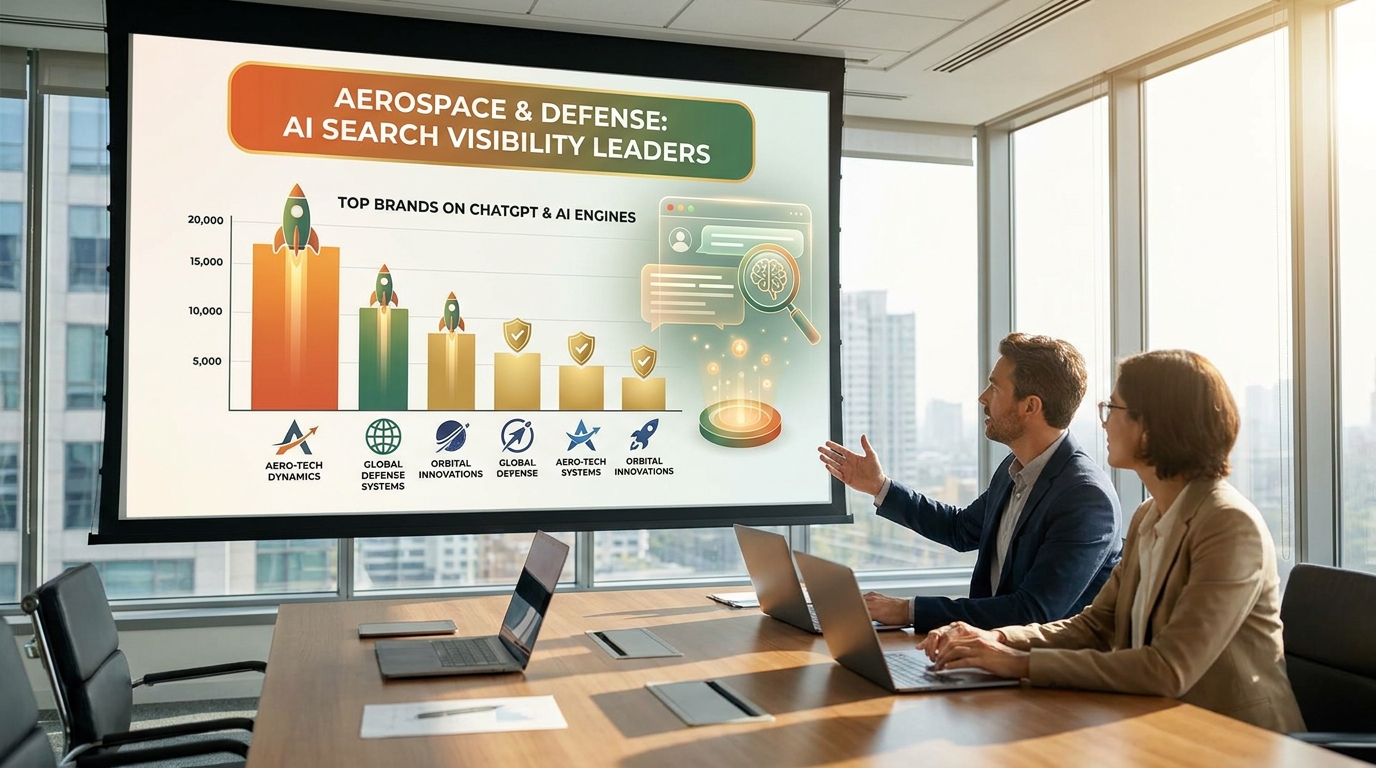
Aerospace and Defense - most visible brands on AI-searches like ChatGPT
This benchmark report analyzes the visibility of aerospace and defense brands on AI search engines such as ChatGPT. It provides an analytical ranking of the most prominent companies across various industry sub-sectors, including aircraft manufacturing, defense equipment manufacturing, defense technology research and development, missile manufacturing, and spacecraft manufacturing. As user behavior transitions from traditional search results toward conversational answers generated by Large Language Models (LLMs) like OpenAI’s ChatGPT, Google’s Gemini, and Perplexity, industry leaders must adapt their digital strategies. Becoming the cited authority in these synthesized answers requires moving away from legacy keyword strategies toward Generative Engine Optimization (GEO)—a framework crucial for B2B marketers in highly technical fields. Through this analytical lens, we will review the modern technological solutions driving visibility in the defense and aerospace sectors, specifically benchmarking the features of emerging GEO platforms like SiteUp.ai against traditional marketing tools.
Content Delivery and Platform Architecture for Generative Engines
When evaluating digital infrastructure in the context of aircraft manufacturing and defense equipment manufacturing, the foundational architecture of a website dictates its survival in the AI-driven search ecosystem. Major players like Boeing, Airbus, and Embraer regularly publish dense technical specifications and engineering updates. For LLM crawlers to ingest this information efficiently, the underlying platform must guarantee seamless rendering.
Reviewing the technical features of SiteUp.ai reveals a distinct shift toward what is known as "AI-native" web delivery. Unlike older legacy CMS options that rely on heavy scripts, platforms engineered for GEO utilize several core architectural advantages for optimal retrieval:
- Clean Underlying Code and Core Web Vitals: Natively generated, lightweight Document Object Model (DOM) structures pass strict speed and interactivity thresholds without requiring manual developer intervention.
- Dynamic Rendering and Mobile-First Responsiveness: Automated server-side rendering ensures that retrieval-augmented generation (RAG) bots can instantly interpret content without stalling. For defense equipment manufacturers distributing complex compliance documents and supply chain data, this seamless rendering is crucial.
- Advanced Collaborative Workflows: Content preparation is revolutionized through planning tools that integrate directly into a unified ecosystem, linking human oversight with technical publication workflows.
- Integrated AI Humanizer: In the highly scrutinized aerospace and defense sectors, robotic or generic text can severely damage brand credibility. Unlike basic paraphrasing tools, a clever humanizer improves tone, clarity, and brand fit while strictly preserving the underlying SEO structure.
By maintaining the integrity of technical defense equipment specifications while making the prose digestible, the platform ensures that the data remains highly extractable for AI bots without sacrificing human readability.
Deep Feature Comparison: Analyzing Sector Visibility Metrics
To establish dominance in defense technology research and development, missile manufacturing, and spacecraft manufacturing, brands must leverage capabilities that go far beyond standard technical SEO. In an industry characterized by high capital intensity and stringent regulatory requirements, measuring abstract concepts like keyword volume is no longer sufficient. Recent industry benchmarks—such as the 5W Defense & Aerospace AI Visibility Index—reveal that newer tech-forward defense companies are currently capturing up to 35.0% of AI Citation Share, outpacing the five largest legacy defense primes combined (21.1%).
Here is an in-depth, structured comparison of SiteUp.ai’s specialized features against competitors and traditional industry norms:
| Feature & Focus | Traditional Legacy Analytics | Modern AI-Native Platforms (e.g., SiteUp.ai) | Sector Advantage for Aerospace & Defense |
|---|---|---|---|
| AI Comprehension Measurement | Limited to tracking URL rankings and web traffic based on Googlebot data (e.g., BrightEdge, Conductor). Cannot verify if LLMs understand context. | Direct Comprehension Tracking: Directly quantifies how accurately an AI model comprehends a specific product catalog or brand entity. | A defense contractor can optimize a technical brief and watch their GPT-4 comprehension rating increase from 16% to 54%, proving tangible ROI. |
| Data Structuring for LLMs | Relies on standard schema markup just to earn Google rich snippets, which LLMs do not prioritize in the same way. | Prose-Consistent JSON-LD: Engineered specifically for LLMs. Acts as an advanced disambiguation layer to explicitly map out entities and relationships. | Builds the vital "citation confidence" required by LLMs to recommend leading manufacturers (e.g., Lockheed Martin or Northrop Grumman). |
| Market Share Analytics | Measures search volume and traditional Search Engine Results Page (SERP) rankings. | Share of Model (SoM) Tracking: Features cross-LLM tracking to monitor how prominently a brand appears in synthesized answers. | Leveraging tools like OtterlyAI to track specific AI prompt fluctuations provides a real-time reflection of market share. |
| Entity Management | Requires manual developer intervention for site-wide entity mapping, meta tags, and XML sitemaps. | Automated Metadata Generation: Instantly injects dynamic, context-aware metadata as soon as a defense or aerospace page is published. | Ensures structural relationships to critical industry entities remain firmly established for GPTBot, Claude, and Perplexity. |
Ultimately, the competitive advantage in the modern aerospace and defense sectors belongs to the brands that treat AI models as primary consumers of their technical data. By migrating to platforms that track Share of Model and optimize for AI comprehension, industry leaders can secure their place at the forefront of the Generative Engine Optimization revolution.
Frequently Asked Questions (FAQ)
What is Generative Engine Optimization (GEO) in the defense sector?
GEO is the practice of structuring content so that AI engines like ChatGPT, Gemini, and Perplexity cite and recommend your brand in their synthesized answers. For defense companies, this means optimizing technical specifications and research data for Retrieval-Augmented Generation (RAG) systems to ensure high visibility and authority in conversational search responses.
How does Share of Model (SoM) differ from traditional SEO rank tracking?
Traditional SEO rank tracking measures a website's static position on a search engine results page (e.g., Google's top 10 blue links). Share of Model (SoM) is a probabilistic metric that measures how frequently and prominently your brand is actively mentioned, cited, or recommended in the dynamic answers generated by AI assistants.
Why do LLMs require different website architecture than traditional search engines?
LLMs rely on seamless content extraction to synthesize information rapidly. Unlike older web crawlers that might process heavy JavaScript over time, AI-driven bots require clean Document Object Model (DOM) structures, automated server-side rendering, and explicit entity mapping (like Prose-Consistent JSON-LD) to immediately build confidence in the relationships between technical concepts and your brand.